

 Image 1 of 1
A guided journal for helpers carrying burnout, compassion fatigue, secondary traumatic stress or moral injury
Helping work can leave marks that are hard to see. Tiredness that sleep doesn't fix. Caring that has gone quiet. A story from work that keeps following you home. A decision you still think about at night.
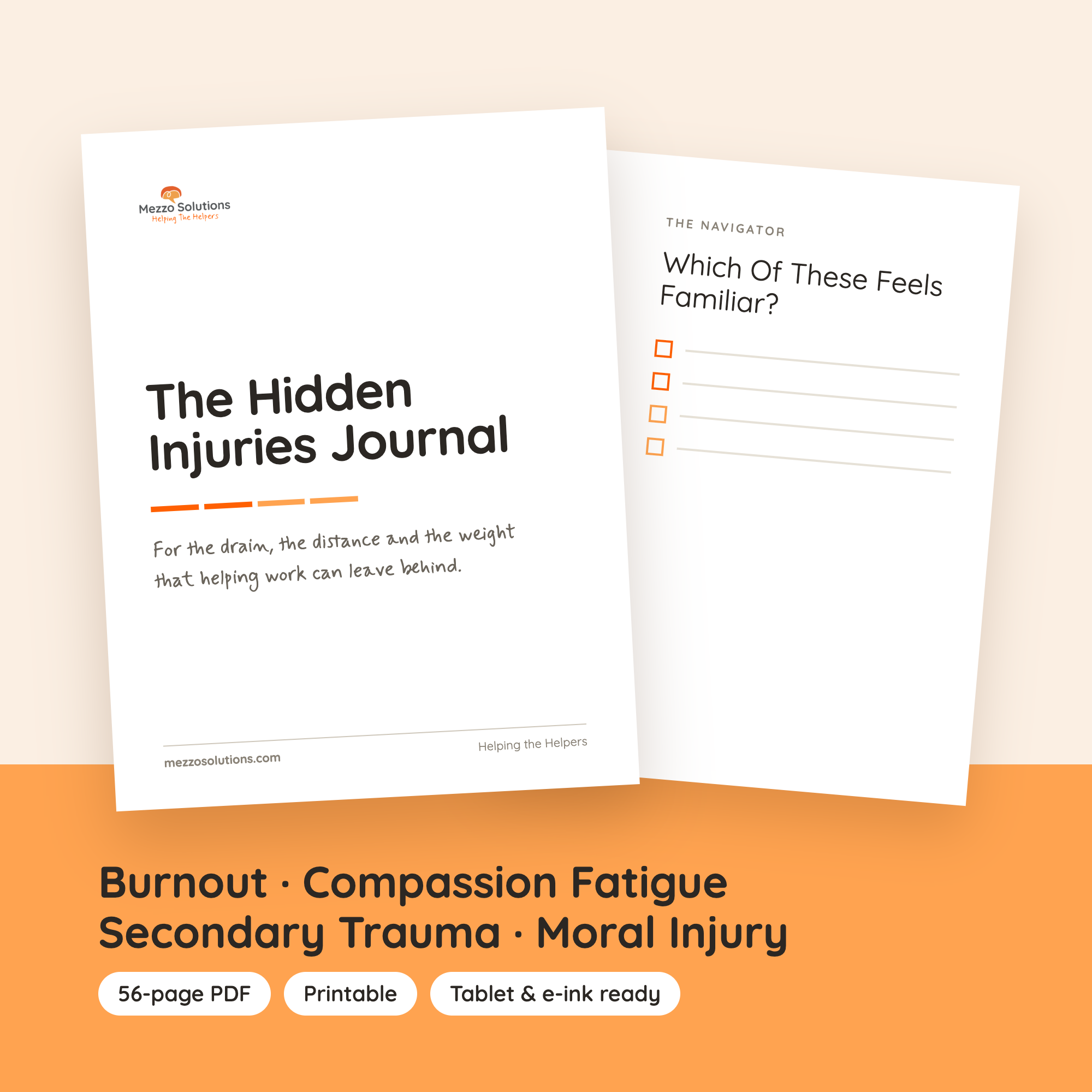
The Hidden Injuries Journal gives you a place to look at what you're carrying, without having to decide first what it is. It covers four areas helpers often experience: burnout, compassion fatigue, secondary traumatic stress and moral injury. A short Navigator at the front helps you notice which ones feel familiar right now, then points you to the section to start with.
Each section stands on its own. Use one or all four, in any order, at your own pace. You'll finish with a one-page plan for prevention and recovery that's specific to you, and a way to prepare for a conversation with your supervisor if you need to ask for change at work.
It's written by people who work alongside helpers, grounded in published research, and delivered as an instant PDF download. Print it at home with minimal ink, or open it in a note-taking app on your iPad or Android tablet, or on an e-ink writing tablet such as reMarkable, Kindle Scribe, Kobo, Boox or Supernote, and write directly on the pages with a stylus.
WHAT'S INSIDE
The Navigator: sixteen plain-language statements to help you choose where to begin. No scores, no labels.
Four self-contained sections, each with a plain explanation, signs to look for, a hands-on tool, seven daily prompts and a closing reflection.
Four tools: a workplace conditions audit, a fill-and-drain battery, a "what came home" log, and a values reflection for moral injury.
28 guided prompts you can take one a day or at your own pace.
My Plan: two pages that bring together your warning signs, supports and commitments.
The Ask: a one-page guide for preparing a conversation with a supervisor.
When to reach for more support, a contacts page, and five free-writing pages.
WHO IT'S FOR
Anyone in helping work who feels drained, disconnected, or disillusioned, or simply wants to check in with themselves. That includes:
Social workers, counselors and therapists · nurses, physicians and other healthcare staff · first responders and dispatchers · teachers and school staff · case managers and advocates · caregivers and volunteers · supervisors who want to understand what their teams are carrying
FAQ
Do I need to know which of the four I'm dealing with? No. The journal doesn't assume you have any of them, and it won't diagnose you. The Navigator helps you find a starting point, and you can move between sections freely.
How long does it take? Each section has seven prompts, so one section takes about a week at a prompt a day. Many people focus on one or two sections. There's no deadline.
Can I print it more than once? Yes. Print as many copies as you need for your own use, so you can come back to it whenever things shift. The pages are designed to use very little ink.
Can I use it on a tablet or e-ink device? Yes. Import the PDF into an annotation app such as GoodNotes, Notability, Noteshelf or Samsung Notes, or upload it to an e-ink writing tablet, and write on the pages with a stylus. The clean, high-contrast layout reads well on e-ink screens.
Is this a replacement for therapy? No. It's a reflection tool, not treatment. It includes guidance on when to reach out to a mental health professional, and crisis contacts.
